
Projects ·
An industrial mixer back in production after a drive rebuild
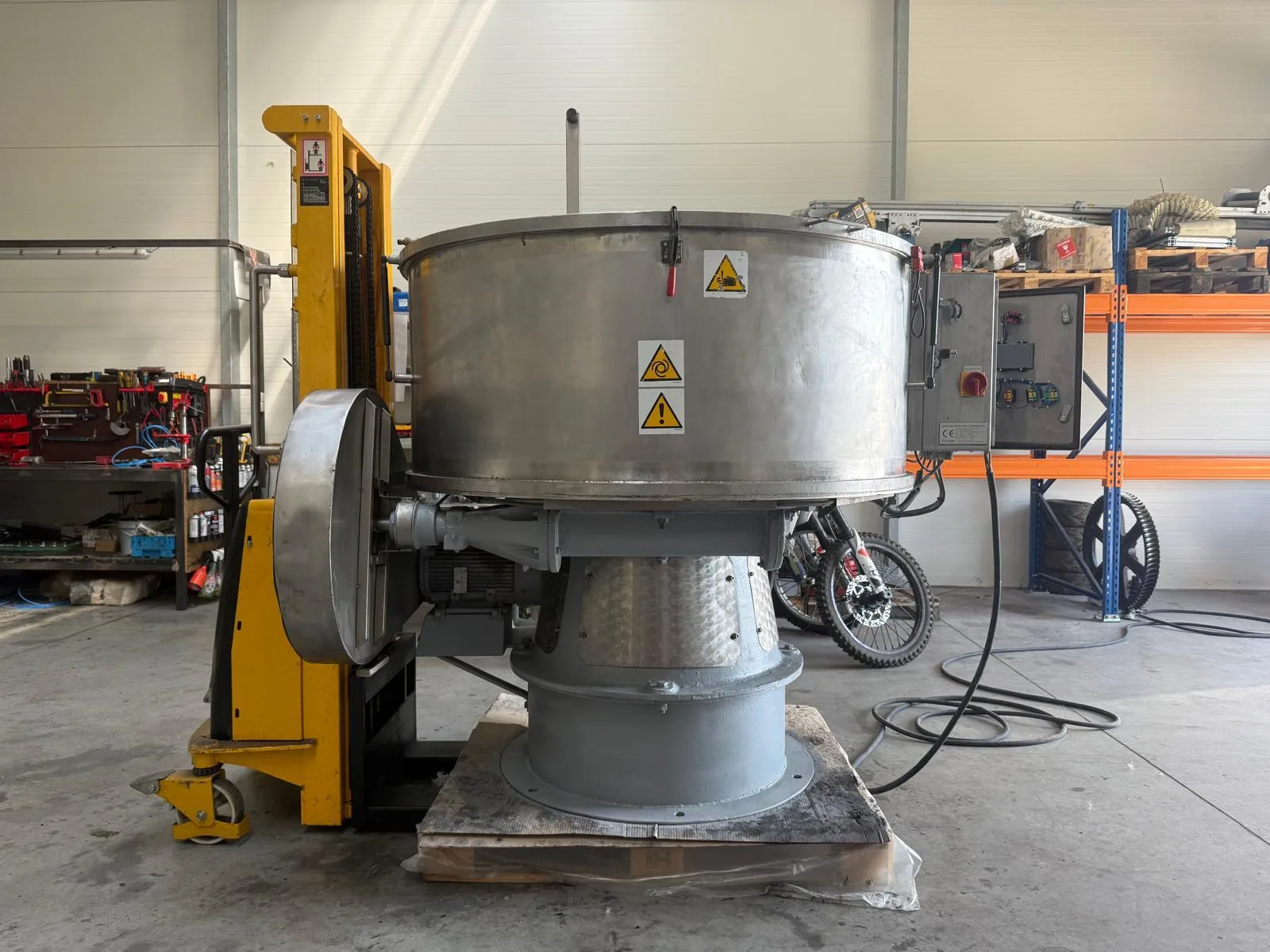
A worn drive on a Sauer mixer — repaired, rebuilt and returned to production.
What arrived
A mixer after years of service, with a rotation drive needing stripping down to the shaft itself:
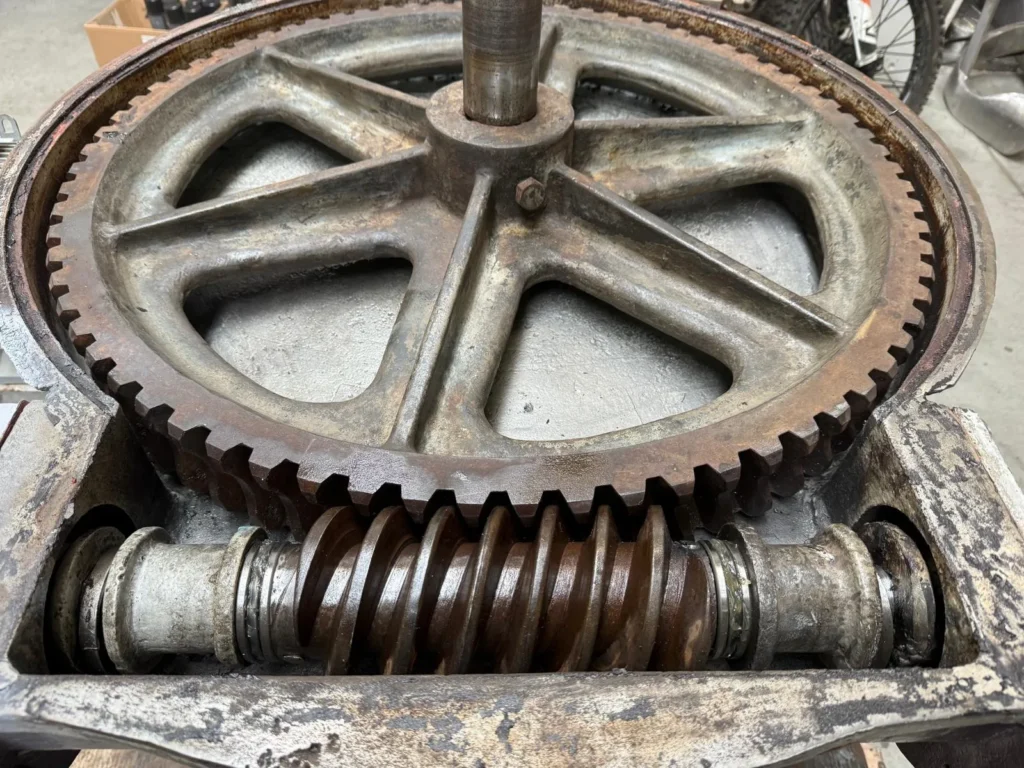
- A worn rotation assembly — gear and drive worm both for replacement.
- Bearing seats past their limits — shaft surfaces outside working dimension.
- Damaged shaft supports — cast iron parts that had been repaired before.
- Worn seals — a complete set of shaft seals and gaskets for replacement.
How the repair went, step by step
-
Strip down and clean
Dismantling as far as the service work required, and washing the components once apart.
-
Rotation shaft reconditioning
Bearing seat surfaces brought back so the assembly returned to working dimension.
-
Cast iron welding
Rebuilding the rotation shaft support and the support for the worm shaft that drives the mixer.
-
New drive train
New gear and drive worm — parts supplied by the customer.
-
Fitting the worm
Turned to the required dimension, with bearings selected to suit the assembly.
-
Grinding the gear
Correcting the gear height, which was preventing the drive from going together properly.
-
Bearings, seals, oils
A complete set of bearings, shaft seals and gaskets, plus an oil change.
-
Reassembly and paint
The unit rebuilt after the work and protected with a paint coating.
The result
The unit went back to the customer working and checked:
- A complete assembly rebuilt — after reconditioning, with a new rotation drive.
- Protected with paint — applied once the mechanical work was finished.
- Handover with the customer — function confirmed when the unit was returned.
What the customer got
A machine instead of an investment
The drive repaired rather than the whole unit replaced.
Machining and welding in one place
Turning, grinding, cast iron welding and assembly without sending parts around subcontractors.
Parts fitted, not compromised
The worm turned to size, bearings matched to the assembly, the gear corrected by grinding.
Clear advice at handover
We said what to watch after start-up: the welds and the bearing seating.
Welding cast iron — the hardest part of a repair like this
Cast iron is brittle and very sensitive to thermal stress. Weld it badly and the crack does not appear in the weld but next to it, in the parent material — often only after the machine has been running for a few days. So repairs like this are done with the heating and cooling of the part controlled, not quickly at the bench.
On this job it was harder still, because the rotation shaft support had already been repaired once before — we were laying a new weld over an existing one. A part like that has to be cleaned back to sound material and its geometry rebuilt so the bearing seats evenly, because otherwise the whole shaft reconditioning is pointless.
We did the same on the support for the worm shaft that drives the mixer rotation. We flagged both places to the customer in the report as points to watch after start-up — honest information about what is worth checking is part of the repair, not a sign of doubt.
When repair beats buying new
On machines that have been in a plant for years, the usual problem is not the failure itself but parts availability. The maker may be out of the market, the catalogue may not cover older versions, and a substitute means altering mountings or changing working parameters. Reconditioning avoids that, because it works with what is there.
The second argument is time. A new mixer is not only the cost of the unit — it is removing the old one, adapting the foundation and services, and the downtime while it is delivered. Repairing the existing machine fits inside the service window the plant was going to take anyway.
The limit is real, though, and we say so plainly: if the body is cracked through, or the geometry cannot be repeatably restored, the repair becomes a prosthesis. Then, rather than taking the job, we tell the customer what to look for in a replacement.
What to have ready when you report a machine
The more we know before arriving, the shorter the path from report to quotation. We do not need full technical documentation — the basics are usually enough.
- Type and designation — the nameplate, if it is still legible.
- Symptoms — noise, run-out, seizure, oil leak, resistance when turning.
- Photographs of the drive assembly — including anything already repaired.
- Repair history — previous welds and replacements change the scope considerably.
- The service window — when the machine can be taken out of service.
After the inspection we set out the scope, split into what is necessary and what is worth doing while the unit is apart anyway. You decide where the line goes.
Related services
Industrial machine servicing
Servicing of production machinery: fault diagnosis, breakdown repairs and scheduled inspections. We come to yo…
Reconditioning of industrial and mechanical components
Reconditioning of shafts, gearboxes, spindles, motors, conveyors, hydraulic cylinders and pumps. Restored to s…
Maintenance support
Standing care of your machine fleet: inspections, critical spares to hand and a response to breakdowns without…