
Services · Cylinder reconditioning
Telescopic cylinders
Reconditioning of multi-stage cylinders in our own machining facility. We restore full function even on complicated designs where parts are no longer supplied.
Cylinder reconditioning
Manufacture and reconditioning of telescopic cylinders for industry: repairs, seals, parts made to order, upgrades and pressure testing. Wrocław, Poland.
Our specialisations
Multi-stage sealing
Each stage needs its seals matched precisely and sealed against the next, while keeping friction low enough to extend properly.
Concentricity
The accuracy with which each stage is guided is critical — deviations cause uneven wear and, eventually, jamming.
Extension sequence
The order in which stages extend depends on getting the piston areas and control pressures right.
Structural strength
A long stroke in a limited diameter means the structure has to be reinforced against buckling at full extension.
How a telescopic cylinder works
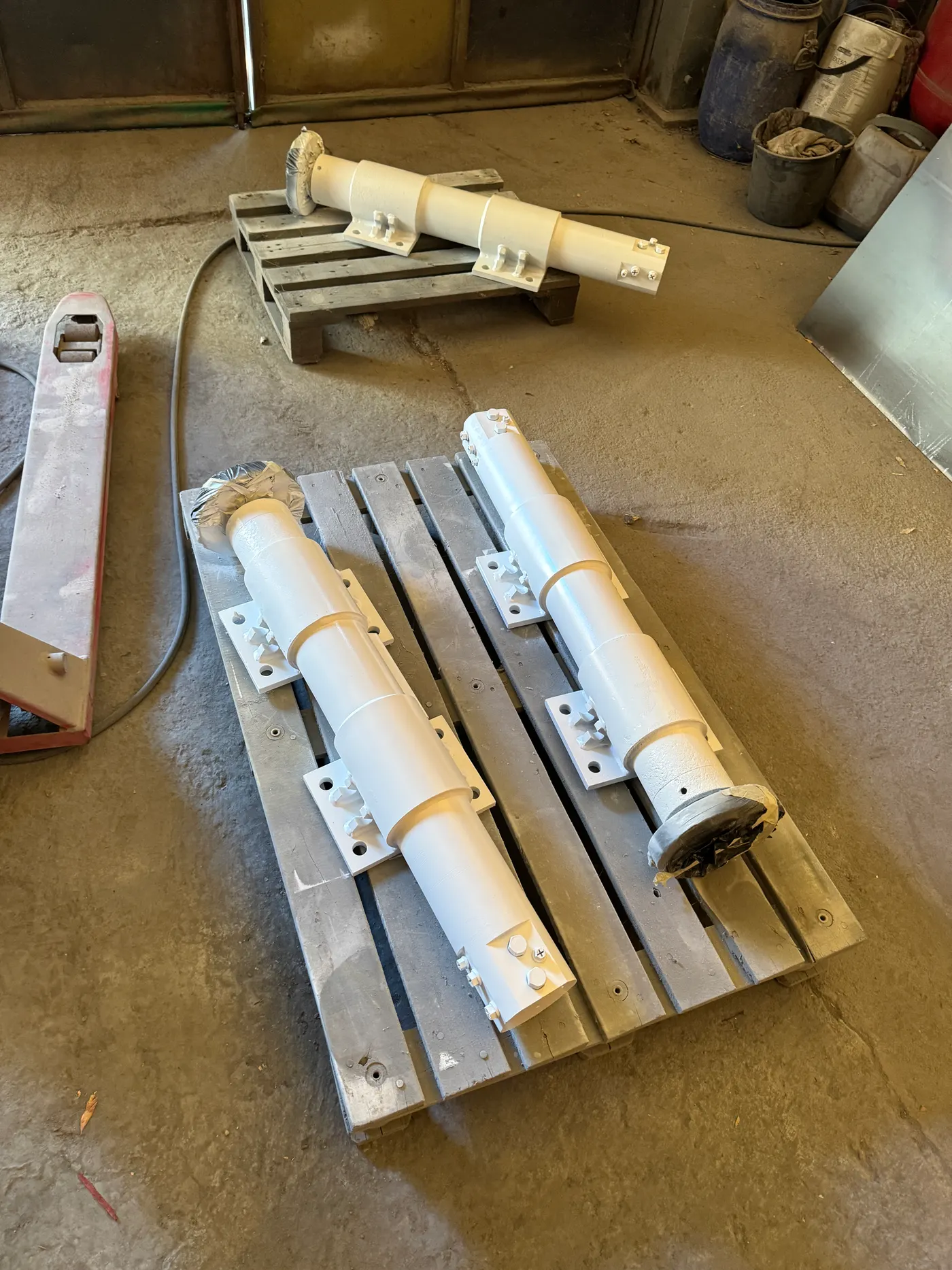
A telescopic cylinder consists of several barrels of progressively smaller diameter, fitted concentrically one inside the other. A typical design has two to five stages, with each stage acting simultaneously as the rod for the stage before it and the barrel for the stage after. That is what allows a stroke five to seven times the collapsed length of the unit.
The order in which the stages extend depends on the ratio of the working piston areas, and can be arranged in different ways. In the most common solution the largest-diameter stage extends first, producing the greatest force, followed by the smaller ones. Alternatively the sequence can be forced with valves or flow restrictors, which allows the reverse order — smallest stage first.
The mechanical design demands precision. Every stage carries a piston seal on the inside and a rod seal on the outside, plus guides to hold concentricity. Wall thicknesses are greater than on a standard cylinder, because the stresses are higher and because buckling at full extension is a real failure mode.
Why these are harder to recondition
A single-stage cylinder has one bore, one rod and one sealing set. A four-stage telescopic has four of each, and they all have to work together. Two things go wrong most often.
Stages that no longer extend in sequence. Usually a seal leaking between stages, sometimes a blocked restrictor. The symptom is a tipper body that rises unevenly or stops partway.
Scored intermediate stages. Because each stage is both a rod and a barrel, damage to its outer surface destroys the seal of the stage outside it. One scored stage therefore tends to take out the seals either side of it.
Both are fixable, but both need the unit fully stripped and every stage measured — which is why we quote after inspection rather than from a photograph.
Where we see them
Tipper bodies, cranes and lifting platforms make up most of the work. These are units that live outdoors, take road salt and grit, and are often left extended in bad weather — so corrosion on the intermediate stages is the normal finding, not the exception.
Where the maker no longer supplies a stage or a seal kit, we make the part. That is the usual reason a telescopic cylinder ends up here rather than at a dealer.
Related services
Bosch Rexroth cylinder reconditioning
Reconditioning of Bosch Rexroth hydraulic cylinders: end cushioning, stroke measurement, rod chrome plating an…
Cylinders with safety valves
We build and service hydraulic cylinders fitted with safety valves. Valve calibration, pressure testing and do…
Double-acting cylinder reconditioning
Reconditioning of double-acting hydraulic cylinders: diagnosis, seals, rods, honing and pressure testing. Hard…
Before you call
The three questions customers ask most often — answered before we raise an invoice.
Sending parts to us from abroad
We are based near Wrocław in south-west Poland, inside the EU. Parts arrive here by courier or pallet freight from across Poland and from EU countries — there is no customs clearance on shipments sent within the EU, so a pallet from Germany or Czechia moves the same way a domestic one does.
1
Send photos first, not the part
A photo of the nameplate, a photo of the whole unit and a line about what it does wrong. We will tell you whether it is worth reconditioning before you pay for freight.
2
Drain the oil
Hydraulic units must be drained before dispatch — couriers refuse them otherwise, and a leaking pallet is usually rejected on arrival.
3
Pallet, not a parcel
Anything above roughly 30 kg or 1.5 m travels safest strapped to a pallet, with the rod end protected. Long cylinders need the rod retracted and secured.
4
Send it to the workshop address
ul. Stalowa 1-13, hala 17, 55-330 Błonie, Poland. Put your company name and a contact number on the paperwork so we can match the pallet to the enquiry.
We can quote and invoice in EUR. If you are a VAT-registered business in another EU country, tell us your VAT number when you ask for the quote. Return freight is arranged the same way the part came in — we will confirm the cost together with the quotation, before any work starts.