
Services · Cylinder reconditioning
Double-acting cylinder reconditioning
Full reconditioning of double-acting hydraulic cylinders. Hard chrome plating is done in house, so the critical step is under our own control.
Cylinder reconditioning
Reconditioning of double-acting hydraulic cylinders: diagnosis, seals, rods, honing and pressure testing. Hard chrome plating in our own facility.
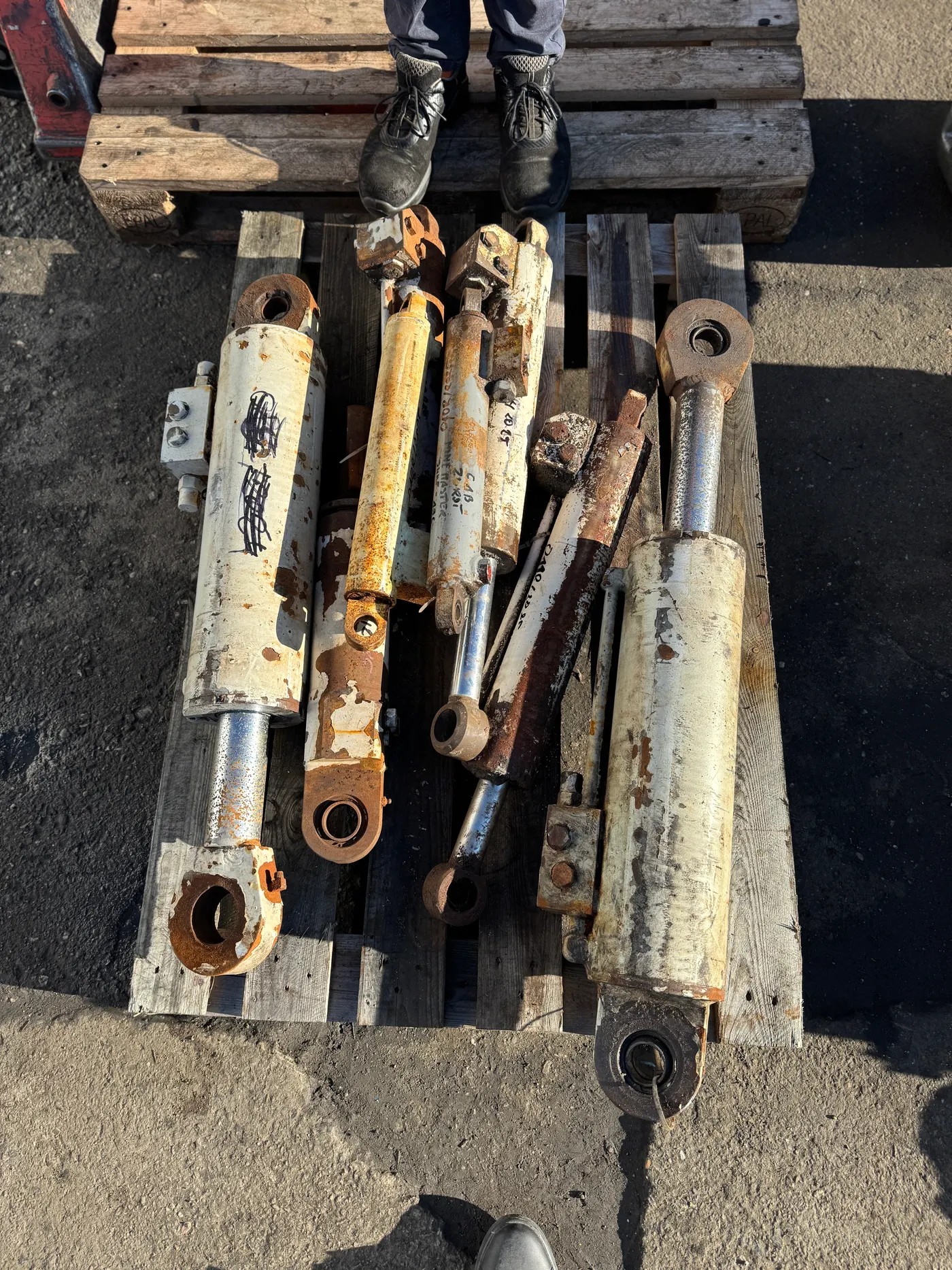
Our specialisations
Piston rod reconditioning
Grinding, hard chrome plating and final polishing of the working surface to Ra 0.2–0.4 µm.
Bore reconditioning
Honing and restoration of dimensional tolerances, including reconditioning coatings where the bore is badly worn.
Sealing system
Complete replacement of the piston, rod and guide seals with new parts.
Mountings
Repair or replacement of heads, joints and mounting bushes.
How a double-acting cylinder is built
The double-acting cylinder is the most versatile actuator in hydraulics. The barrel holds two chambers separated by the piston, which is connected to a rod passing through one or both heads. Feeding fluid to either chamber lets the cylinder generate force on both extension and retraction.
That is the essential difference from a single-acting unit: movement is actively controlled in both directions. The piston-side chamber produces the higher force, because the full piston face is working; the rod-side chamber produces less, reduced by the cross-section of the rod. That area ratio defines the cylinder’s characteristics and is chosen to suit the application.
Industrial designs come in several variants: single rod (the most common), through rod for equal force in both directions, with end cushioning for high speeds, with a solid rod for stiffness, and with additional guiding where side loads are expected. Standard working pressures run 160–250 bar, and reinforced versions 350–400 bar.
Every job starts with measurement
Reconditioning begins with a technical inspection: tolerances measured, working surfaces assessed, and the cause of the failure identified. That last part matters — a cylinder that failed for a reason will fail again if the reason stays. Contaminated oil, a misaligned mounting or side loading will destroy a new sealing set as fast as it destroyed the old one.
On that basis we set the scope and tell you whether the job is worth doing at all.
Hard chrome plating of piston rods
The critical process in reconditioning a double-acting cylinder is hard chrome plating of the rod. It gives the surface its resistance to wear and corrosion, and the tribological properties the seals need to survive.
We have our own plating bay, which means full control over the quality and no risk of the rod being damaged in transit to a subcontractor.
The sequence is: precision grinding of the rod to h9–h10, surface cleaning and preparation, electroplating to a coating thickness of 20–40 µm, then final polishing to Ra 0.2–0.4 µm. The resulting coating hardness is 850–1000 HV, which is what makes it stand up to abrasive wear.
For special applications we match the coating to the working conditions: hard chrome where abrasion resistance is what matters, composite chrome where there is a risk of scuffing. We decide after the measurements and after a conversation about how the cylinder actually works in the machine.
Where these cylinders work
- Metal forming and stamping machinery
- Lifting and positioning systems in automation
- Hydraulic presses and pressing systems
- Construction machinery and road equipment
- Control mechanisms on production machinery
- Test rigs and research equipment
Related services
Bosch Rexroth cylinder reconditioning
Reconditioning of Bosch Rexroth hydraulic cylinders: end cushioning, stroke measurement, rod chrome plating an…
Cylinders with safety valves
We build and service hydraulic cylinders fitted with safety valves. Valve calibration, pressure testing and do…
Fletcher cylinder reconditioning
Reconditioning of cylinders for Fletcher mining machinery: roof supports, lifting and extension rams. No waiti…
Before you call
The three questions customers ask most often — answered before we raise an invoice.
A hydraulic cylinder losing force — five common causes
The machine runs slower than it used to, the cylinder will not reach the end of stroke, or it creeps down under load
ReadReconditioning or a new cylinder — how to work out which pays
The cylinder can be repaired, but it is not clear whether reconditioning or buying new works out cheaper
ReadSending parts to us from abroad
We are based near Wrocław in south-west Poland, inside the EU. Parts arrive here by courier or pallet freight from across Poland and from EU countries — there is no customs clearance on shipments sent within the EU, so a pallet from Germany or Czechia moves the same way a domestic one does.
1
Send photos first, not the part
A photo of the nameplate, a photo of the whole unit and a line about what it does wrong. We will tell you whether it is worth reconditioning before you pay for freight.
2
Drain the oil
Hydraulic units must be drained before dispatch — couriers refuse them otherwise, and a leaking pallet is usually rejected on arrival.
3
Pallet, not a parcel
Anything above roughly 30 kg or 1.5 m travels safest strapped to a pallet, with the rod end protected. Long cylinders need the rod retracted and secured.
4
Send it to the workshop address
ul. Stalowa 1-13, hala 17, 55-330 Błonie, Poland. Put your company name and a contact number on the paperwork so we can match the pallet to the enquiry.
We can quote and invoice in EUR. If you are a VAT-registered business in another EU country, tell us your VAT number when you ask for the quote. Return freight is arranged the same way the part came in — we will confirm the cost together with the quotation, before any work starts.