
Services · Production processes
3D design and FEA
We design machines and equipment, dies, welding and soldering tooling, fixtures and spare parts — from a sketch, a drawing or a worn original. Structures are checked by FEA, and welds are assessed for fatigue as well as static strength.
What we do
- Machines and equipment, including rebuilds for a new part
- Dies, press tools and fixtures
- Welding and soldering jigs
- Spare parts rebuilt from a worn original or a 3D scan
- FEA calculations with a report on the assumptions
- Fatigue assessment of welded joints
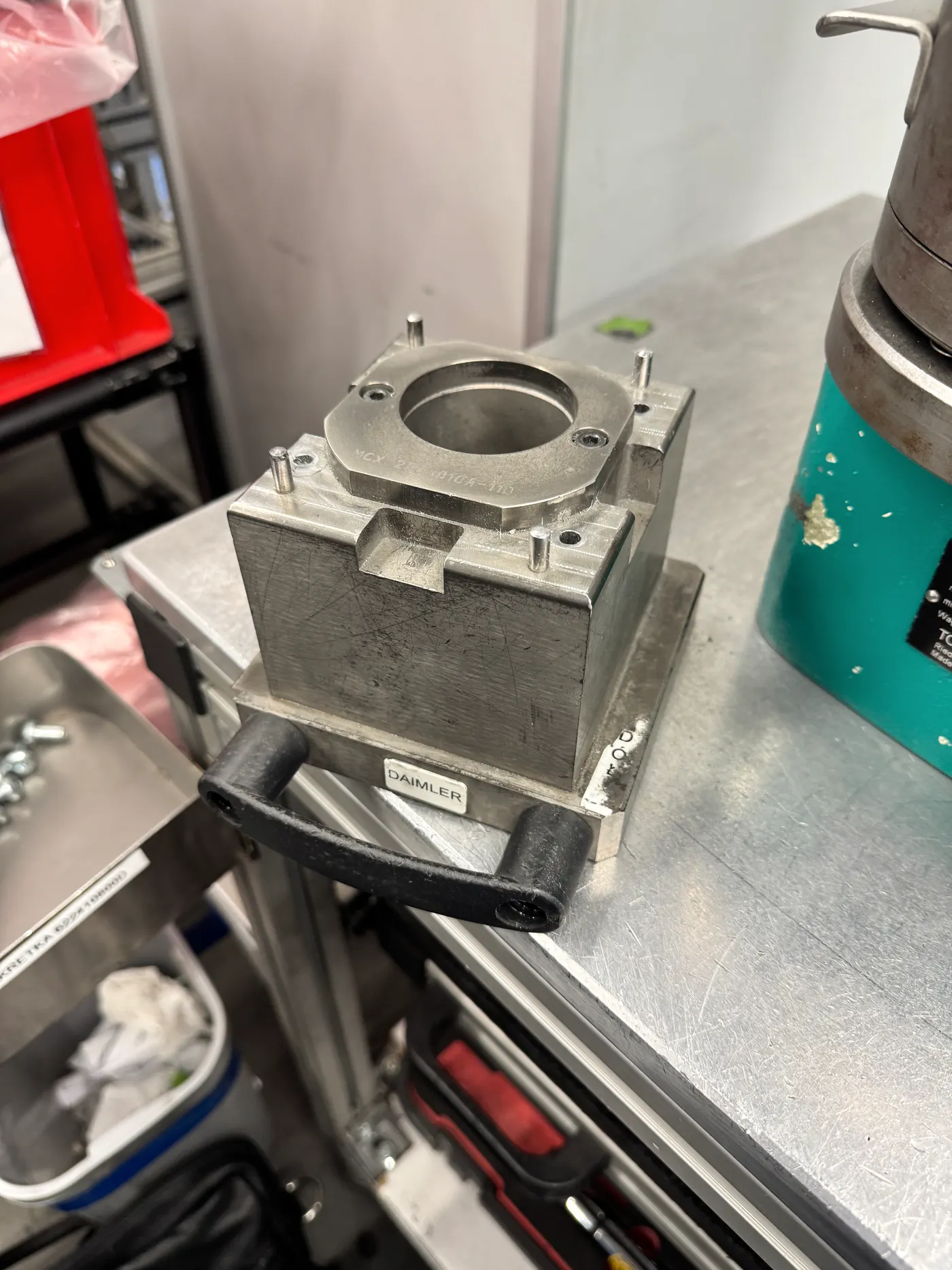
From the model to the finished part
Our specialisations
Machines and equipment
Complete machines and rebuilds of existing ones, where the product changed but the machine did not.
Dies and fixtures
Press tools, dies and work-holding, designed around the part rather than around a catalogue.
Welding and soldering tooling
Jigs that hold the joint through the heat, which is what decides whether the assembly comes out to dimension.
FEA calculations
Stress and deflection worked out before anything is cut, with the assumptions written down.
Weld fatigue
Cyclic structures do not fail in the parent material, they fail at the weld. That is calculated separately.
Spare parts
Rebuilt from a worn example or a 3D scan when the maker no longer supplies them.
What we design
Machines and equipment. Complete units, and — more often — rebuilds of machines that have to handle a part they were not built for. The second is usually the better investment, because the frame, the drives and the controls are already there.
Dies, press tools and fixtures. Designed around the part and around the press you actually have, including the tonnage and the shut height, not around an ideal machine.
Welding and soldering jigs. These exist to hold a joint against the distortion that heat causes. A jig designed without accounting for how the assembly will pull as it cools produces parts that are dimensionally correct on the bench and wrong once released.
Spare parts. Where the original exists only as a worn example, we measure it or 3D scan it and rebuild the model. Where the original design had a known weakness, we say so and propose the change rather than reproducing the failure.
Hydraulic cylinders, designed to fit the machine rather than the nearest catalogue size — see custom cylinders.
FEA — worth calculating before it gets welded
Finite element analysis answers a question that is expensive to answer any other way: will this hold, and where will it fail first. On a one-off structure there is no prototype series to learn from, so the calculation is the only warning you get.
We calculate stress and deflection under the loads the structure actually sees, including the load cases people forget — lifting, transport, and the moment somebody stands on it. The output is not a colourful picture but a report stating the loads assumed, the constraints applied and the safety factor reached. Those assumptions are the part worth arguing with, which is why they are written down.
Fatigue in welded joints
A structure that cycles does not fail in the parent material. It fails at a weld, at a notch, usually at a fraction of the static strength and after a number of cycles nobody counted.
So for cyclically loaded structures we assess the welds separately: the notch effect at the joint, the joint classification, and the number of cycles to failure at the stress range the structure actually sees. That calculation decides things a static check never would — whether a fillet should be a full penetration weld, whether a transition needs grinding out, and whether the detail needs redesigning altogether.
This is the difference between a structure that lasts the life of the machine and one that cracks in its second year.
What you get
- 3D model and 2D drawings in STEP, DWG and PDF
- Material specification and the standards the parts are made to
- A calculation report with the assumptions, the load cases and the results
- A visualisation, where the point is to agree the concept before anything is cut
Design work leads straight into manufacture here — CNC machining, welding and assembly and testing are in the same building, which means the person who designed it hears about it if it is awkward to make.
Where most orders are variants of the same product, the model and drawings can be generated from rules instead of drawn again — see SOLIDWORKS automation.
Related services
3D scanning of parts and machines
We scan parts with no documentation, machines for installation design, and components to be reproduced. A scan…
Assembly and testing
Assembly and testing of machines, assemblies and industrial equipment. Pressure and function testing with docu…
Sandblasting and wet painting
Sandblasting and wet painting of steel structures, machine parts and assemblies. Thorough surface preparation …
Sending parts to us from abroad
We are based near Wrocław in south-west Poland, inside the EU. Parts arrive here by courier or pallet freight from across Poland and from EU countries — there is no customs clearance on shipments sent within the EU, so a pallet from Germany or Czechia moves the same way a domestic one does.
1
Send photos first, not the part
A photo of the nameplate, a photo of the whole unit and a line about what it does wrong. We will tell you whether it is worth reconditioning before you pay for freight.
2
Drain the oil
Hydraulic units must be drained before dispatch — couriers refuse them otherwise, and a leaking pallet is usually rejected on arrival.
3
Pallet, not a parcel
Anything above roughly 30 kg or 1.5 m travels safest strapped to a pallet, with the rod end protected. Long cylinders need the rod retracted and secured.
4
Send it to the workshop address
ul. Stalowa 1-13, hala 17, 55-330 Błonie, Poland. Put your company name and a contact number on the paperwork so we can match the pallet to the enquiry.
We can quote and invoice in EUR. If you are a VAT-registered business in another EU country, tell us your VAT number when you ask for the quote. Return freight is arranged the same way the part came in — we will confirm the cost together with the quotation, before any work starts.