
Projects ·
Annual service of an electroplating line
A complete annual inspection of an electroplating line, carried out in one service window.
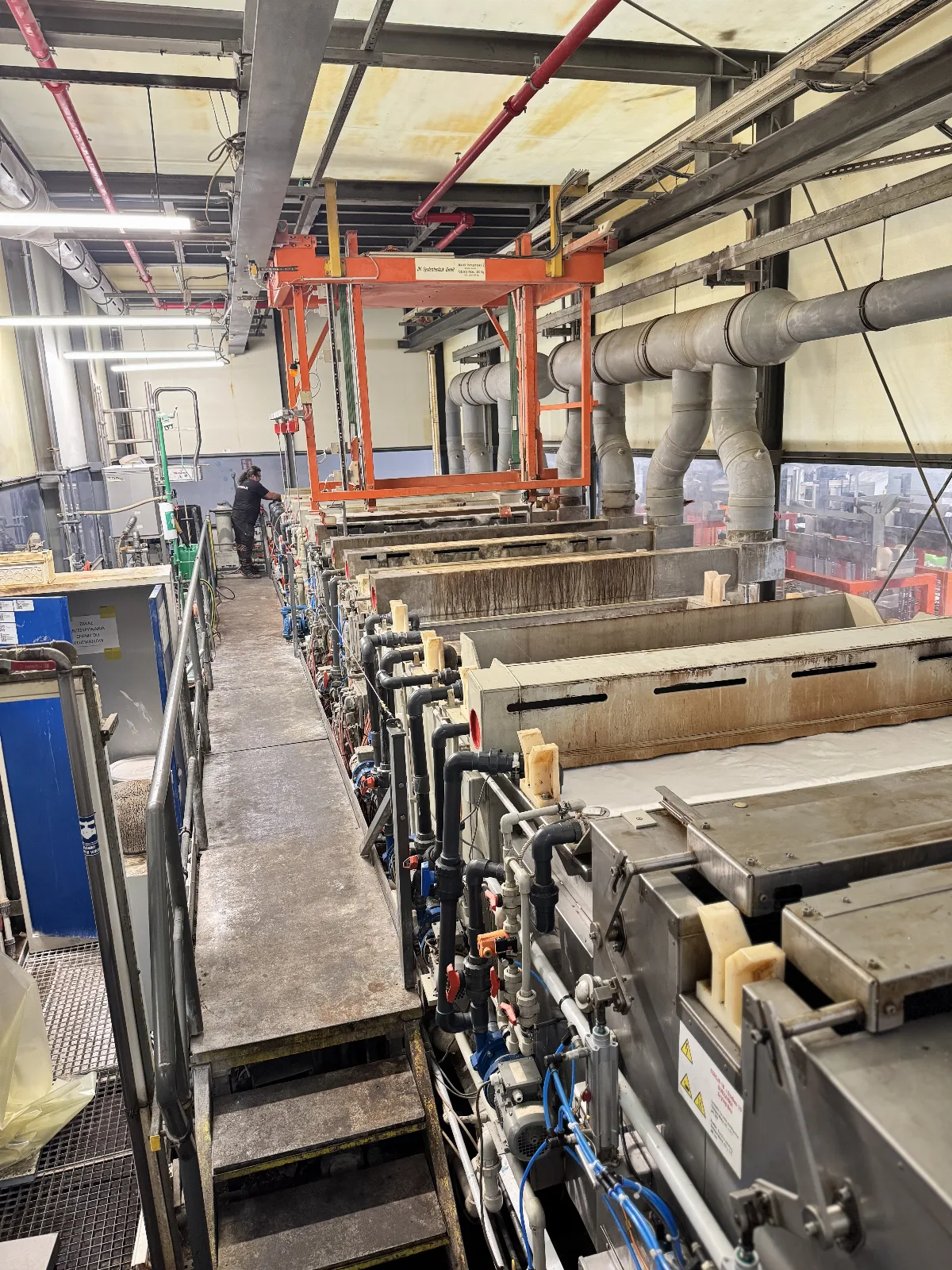
Why a line is serviced as a whole
An electroplating line is a chain of dependent systems, and servicing one without the others rarely holds:
- Extraction and process — blocked ducts change the conditions above every tank at once.
- Transport and process — a carriage that runs badly changes the immersion times.
- Chemistry and hardware — acid attacks hoses, valves and fixings continuously, not occasionally.
- One window — the plant stops once, so everything worth doing gets done then.
What the service covered
-
Ventilation and scrubber
Cleaning the ducts above the tanks and the inlet ducts, cleaning the scrubber and checking the water spray function. The section above the working area was cleaned separately.
-
Lechler and Venturi nozzles
Nozzles dismantled, cleaned and the missing components replaced. On the circulating tanks, the Venturi nozzles were inspected and damaged parts replaced.
-
Drip tray
Tightness checked, cleaned, and visible damage and losses repaired.
-
Pressure set and hydraulic lines
Acid-resistant flexible hoses replaced, valves checked for leaks and drain valves for flow, pipe fixings verified. The blue valves were replaced with orange George Fischer units.
-
Travel rails and carriages
Thorough cleaning of the rails, carriage heads and barcodes. Mechanical and electrical inspection of the carriages: wheels, guides, rollers, cabling and sensors. Bearing housings greased, play on gearboxes and shafts checked.
-
Access and entry doors
Brush seals replaced, hinges tightened and greased, adjustment carried out and a door closer fitted at the entry door.
-
Tanks, dryers and heating
Tanks cleaned and dried from the outside, dryers and internal ducts cleaned, oil drained from the lower sections, electric heating checked on five tanks.
-
Pneumatics and structure
Pneumatic system checked for air leaks, damaged components replaced, structural fixings repaired, the shelf and electrical box at the entrance replaced, glazing cleaned along the whole line.
What the customer got
The whole line in one stoppage
More than a dozen areas covered in a single service window, rather than split across several visits.
Extraction back to specification
Clear ducts and clean nozzles restore the ventilation parameters the line was designed around.
Fewer failures from small things
Hoses, valves, brush seals and fixings replaced before they become the cause of an unplanned stoppage.
A full record of the inspection
A report listing the work done, the parts used and the points to keep an eye on.
Why the whole line, and why once a year
An electroplating line is not a set of independent machines. Extraction, chemistry, transport and heating all act on the same process, and a fault in one shows up as a quality problem attributed to another. Blocked ducts change the conditions above every tank. A carriage that runs unevenly changes immersion times. Neither looks like its own failure — both look like a process that has drifted.
That is why the service covers the line as a whole and happens in a single window. The plant stops once, and everything worth doing gets done while it is down. Splitting the same work across three visits costs three stoppages and finds less, because nobody sees the line in its entirety.
What acid does to the hardware
The systems around a plating line live in an aggressive atmosphere, and the wear is continuous rather than occasional. Flexible hoses harden and crack. Valve internals seize. Structural fixings corrode where the coating has been breached. None of it is dramatic on any given day, and all of it becomes an unplanned stoppage eventually.
So the service replaces those items on condition rather than on failure — hoses, valve internals, brush seals, fixings. On this line the blue valves were replaced with orange George Fischer units, which is the kind of change worth making while everything is already open.
What you get afterwards
A report listing what was done, what was used and what to keep an eye on. The last part matters most: a line this size always has items that are serviceable now and will not be in a year, and knowing which ones they are is what lets the next shutdown be planned rather than forced.